You finish a match remembering the volleys you missed, but not why you missed them. Your next-session goal becomes “be more consistent”—which gives you very little to practise.
If you want to reduce unforced errors in padel, start by separating a poor decision from a poorly executed shot. Then work on one recurring situation rather than trying to repair your whole game at once. The aim is not timid padel. It is choosing an appropriate level of risk and making your intended shot more repeatable.
1. Decide what counts as an unforced error

Photo by Ricardo IV Tamayo on Unsplash.
For your own practice, use this working definition: an unforced error is a miss on a ball you reasonably expected to manage, given your position, balance and available time. Treat that as a coaching tool, not an official statistical definition.
Do not classify every ball into the net as the same problem. Missing while stretched wide is different from missing a comfortable ball while trying to hit an ambitious target.
After a practice game, sort a few memorable misses into three categories:
- Decision: you chose a shot or target that asked too much of the situation.
- Execution: the choice was sensible, but you did not produce the intended ball.
- Unclear: you cannot confidently explain what happened.
Keep the third category. Guessing at causes can send your next practice session in the wrong direction. Ask a coach to observe the situation rather than deciding that every miss needs a technical rebuild.
2. Give your next shot a job and a margin

Photo by Josh Calabrese on Unsplash.
“Keep it in” is an outcome, not a useful instruction. Before a practice sequence, decide what the shot should achieve.
A simple set of intentions is:
- Stay in the point: choose a manageable ball while you recover your position.
- Maintain pressure: keep your opponents working without demanding an immediate winner.
- Attack: take a more ambitious option when you judge the opportunity suitable.
These are practice labels, not rigid rules. Their purpose is to make your choice clear enough to evaluate.
Next, choose a target area rather than a single perfect landing spot. In this article, margin means the room you deliberately leave between your intended shot and an error boundary, such as the net or an out ball.
If you repeatedly miss while aiming close to a boundary, test a more generous target before changing your entire stroke. Ask: “Would this shot still do its job with less precision?”
For guided work on those decisions, explore the academy’s Tactical Masterclass.
3. Practise one error pattern, not every stroke

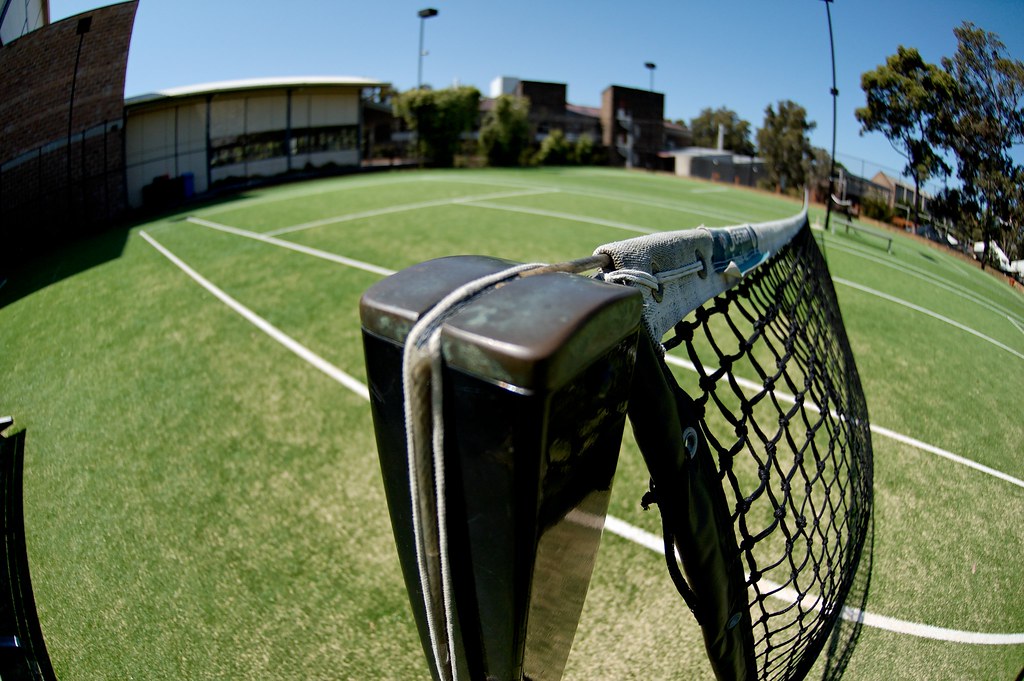
Photo by Mitch Barrie from Reno, NV, USA on Openverse, BY-SA 2.0.
Choose one situation you encounter regularly: a comfortable volley, a manageable return, or a neutral rally ball. Avoid a vague objective such as “fix my forehand.” Describe the situation and the intended response instead.
For example: “On a manageable ball from the back, I will choose a generous target and make my opponent play another shot.”
Try this practice sequence with a partner or coach:
- Agree on the situation. Specify where you start and what kind of incoming ball you want.
- Name the intention. Say whether you are staying in the point, maintaining pressure or attacking.
- Repeat a short block. Keep the starting conditions similar enough to compare attempts.
- Review one thing. Was the target appropriate, and did your ball match it?
- Add variation. Change the incoming ball once the task feels manageable.
Avoid treating a successful repetition as proof that the problem is solved. Equally, do not respond to one miss by adding several new instructions.
The Ace Padel Academy’s approach is Align, Calibrate, Execute: establish the tactical objective, adjust the task and feedback, then practise the intended response. Repetition and feedback take priority over simply accumulating court time.
4. Test the habit in points without rewarding passivity

Photo by Eric Prouzet on Unsplash.
A cooperative exercise lets you rehearse a choice. Playing points lets you check whether you still make that choice when the opponent changes the situation.
Use normal scoring, but give yourself one additional practice objective: recognise your chosen situation and attempt the agreed response. Discuss that objective between short blocks of points, rather than analysing every rally aloud.
Assess the decision separately from the result:
- Sensible choice, successful execution: repeat the approach when the situation fits.
- Sensible choice, missed execution: keep the intention and investigate the execution.
- Unsuitable choice, point won: do not automatically make it your new default.
- Unsuitable choice, point lost: identify the alternative you want to rehearse.
This distinction matters because your goal is not to remove all attacking play. A practice game in which you refuse every opportunity does not test whether you can attack responsibly.
If you are unsure which situations should be manageable at your current standard, use the padel level test as a starting point for discussing your training needs.
5. Build a coaching week around one dependable improvement

Photo by Hermes Rivera on Unsplash.
Bring a specific question to camp: “Why do I miss manageable balls when I try to maintain pressure?” That gives the coach a clearer starting point than “I need consistency.”
A useful week structure is to identify the recurring situation early, repeat an appropriate response, and then test it in match play. Later sessions can revisit whatever breaks down under pressure.
Academy camp days start at 09:00, and padel sessions default to 90 minutes. Plan mornings around the coaching focus, leave breaks between activities, and use afternoon training or match play to revisit it according to your agreed itinerary. This is a planning framework, not a promise of a fixed daily timetable.
Matches against local players are the default. Fitness is optional; fitness sessions default to 60 minutes, and fitness days start at 08:30.
Explore the Advanced Camp if you are looking for a programme to discuss for your next training week.
FAQ
Should I slow down every shot to reduce errors?
No. First check whether the shot choice and target suited the situation. Test less pace where appropriate, rather than making it a blanket rule.
Is an unforced error always a technical problem?
Not in this practice framework. An overly ambitious target or unsuitable shot choice belongs in the decision category, even if the stroke felt clean.
How many errors should I allow per set?
Avoid choosing an arbitrary universal limit. Start by identifying your recurring error situation and compare similar practice tasks over time.
Can a camp guarantee fewer mistakes?
No. Use coaching to establish a clearer diagnosis, practise a response and test it in matches—not to chase a guaranteed error count.
Book your padel week
Camps at The Ace Padel Academy in Valencia start from 400 EUR per player. Bring one recurring problem and a willingness to work on decisions as well as execution.
Message us on WhatsApp with your preferred dates, playing experience and the situation in which you most often give points away. We can discuss a suitable training week.
Related Program
Tactical Masterclass
Written by
The Ace Padel Academy